Text to speech reader for Windows and Linux
A read-aloud app
that is not your screen reader.
A desktop app that opens your EPUB and PDF files and reads them with neural voices in 12 languages. It reads the document, not the menus, and it remembers the sentence you stopped at.
Signed installer for Windows 10 and 11, .deb package for Debian and Ubuntu. 14-day free trial, then €4.99/month. No macOS version.
How it works
Installed and reading in three steps.
Nothing to convert, nothing to upload, no browser tab to keep open.
Install it
On Windows, run the installer: it is digitally signed, so SmartScreen lets it through without the usual scare. On Debian or Ubuntu, install the .deb with sudo apt install ./aurisreader.deb.
Open a file from your disk
Any EPUB or PDF you already have. The file is read from where it lives: there is no cloud library and nothing is uploaded to our servers.
Press play
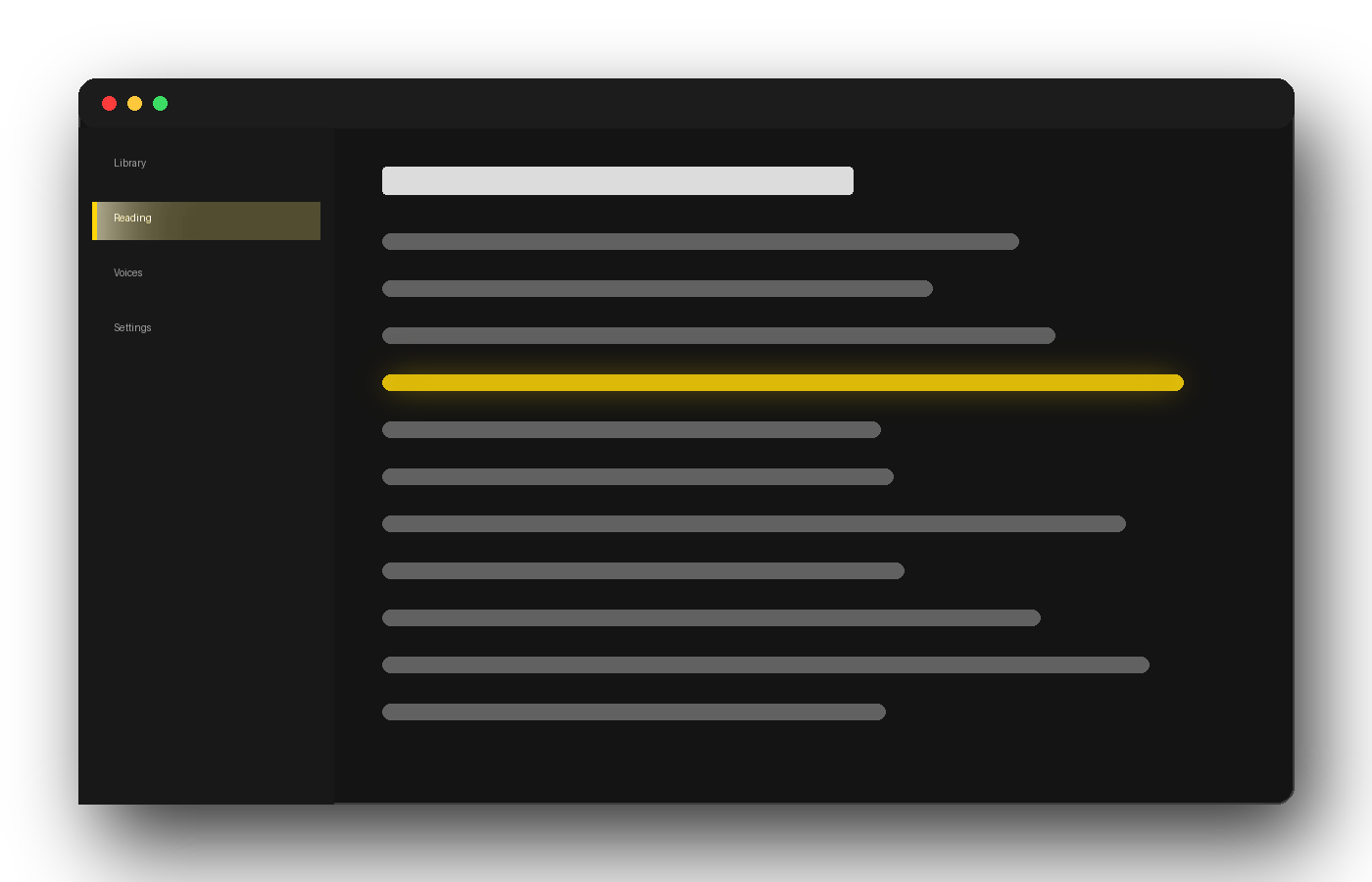
The sentence being read lights up and you can jump back one at a time. Close the app and it reopens that document on the exact sentence where you stopped.
Why Windows makes this awkward
Your computer can already talk. That is the problem.
Windows ships with Narrator, and Narrator will read your document out loud. It will also announce every button, menu, notification and window title it meets on the way, because it is a screen reader: it exists to describe an interface to someone who cannot see it, not to read a book to someone who can.
Edge is the other free answer, and a good one for a PDF you need once. But it has not opened EPUB files since Microsoft dropped the format in 2019, it forgets you the moment you close the tab, and it keeps no library. The free desktop programs that do open everything, like Balabolka, use the SAPI voices installed on Windows, which is exactly the robotic voice most people are trying to get away from.
So the gap is narrow and specific: a desktop app that reads the document and nothing else, with voices you can stand for an hour, that keeps your place between sessions.
What you get
A reader, not an accessibility layer.
It reads the document, and shows you where it is
Each sentence is highlighted the instant it is spoken. A predictive pipeline generates the next few sentences while the current one plays, so there is no pause between them and no gap while it thinks.
- Jump back one sentence with a single control
- Reopens your document on the exact sentence you left
- Light and dark themes, with a large body text by default
More than 20 neural voices, 12 languages
Not the SAPI voices your computer came with. Spanish and English ship with the app, with Spain, Mexico, US and UK accents; ten more languages download from inside it at no extra cost.
- French, German, Italian, Portuguese, Dutch
- Polish, Swedish, Romanian, Bulgarian, Hungarian
- A male and a female voice in every language
PDFs that stop reading the furniture
Before it starts, the app profiles the document and works out what is content and what is decoration, so the running header does not come back on every page.
- Headers, footers and page numbers stay silent
- Learned for each document, not from a fixed list
- Pull quotes no longer interrupt the paragraph
Your files stay on your computer
Your files are opened from your own disk. There is no upload, no cloud library and no copy of your documents on our servers, which is the part the big cloud readers cannot offer.
- With online voices, only the sentence being spoken is sent
- Offline translation is included in every plan
- The app does not track what you read
A book in a language you do not read
Turn translation on and the document is translated as it is read to you. Each sentence goes through with the three before it, so pronouns and names survive instead of turning into nonsense.
- The voice you choose decides the target language
- Ships switched off; you turn it on yourself
- Scanned PDFs need text recognition, in the higher plans
On Linux
A .deb, and one thing it will not do.
Auris Reader ships as a .deb package for Debian and Ubuntu, and it is the same application as on Windows: same voices, same highlighting, same PDF handling, same library. Install it with sudo apt install ./aurisreader.deb.
The difference is what happens when the connection drops. On Windows the app falls back to the voices installed on the system so you can keep listening. On Linux it does not, and that is a decision rather than an omission: the system voices available there sound markedly worse and pick the wrong language often enough that we would rather stop than read your book badly. If you need reading aloud with no connection at all, say so before you subscribe and we will tell you honestly that this is not it yet.
How it compares on the desktop
Three of these cost nothing.
We would rather you knew which ones, and when they are the better answer.
| Auris Reader | Calibre | Balabolka | Edge | Speechify | NaturalReader | |
|---|---|---|---|---|---|---|
| Runs on | Windows, Linux, Android | Windows, Mac, Linux | Windows | Windows, Mac, Android, iOS | Windows, Mac, iOS, Android, web | Windows, Mac, iOS, Android, web |
| Opens EPUB and PDF | Yes | Yes | Yes, and many more formats | PDF only | Yes | Yes |
| Neural voices | Yes, 12 languages | Yes, local | No, system voices | Yes | Yes | Yes |
| Leaves out PDF headers, footers and page numbers | Yes, learned for each PDF | − | − | − | Yes, as an option | Headers and footers, as an option |
| Translates the document while reading it | Yes | − | ~ | − | − | − |
| Reads without uploading your file | Yes | Yes | Yes | Yes | No, cloud library | No, cloud library |
| Saves the reading as an audio file | − | − | Yes | − | Yes | Yes |
| Price | €4.99/month | Free | Free | Free | Subscription | Subscription, or a one-off desktop licence |
Read that table before you pay us anything. Balabolka opens more formats than we do, costs nothing and will save your book as an MP3. Calibre is free, runs on Linux too and has local neural voices. Edge is already installed and is the right answer for a PDF you need once.
Two rows in the middle are where the money goes: cleaning up a PDF so the running header stops coming back, with nothing to switch on, and translating a document while reading it. Balabolka has a translation utility, but it is a separate tool for translating text, not a translation that happens as the voice moves through the page. And if your documents are private, the two subscription apps need them on their servers first.
Third-party platforms, features and pricing models are those published by each vendor on 22 September 2026 and change often. Check their own page before deciding.
What it costs
One plan, and a trial that really is free.
€4.99 / month
Or €49 a year. Taxes included. Cancel in two clicks from your account.
- 14 days free, then it renews unless you cancel
- Up to 2 new documents a day — carrying on with the document you were reading, or reopening one you already opened that day, does not count
- 2 devices signed in at once
- All 12 voice languages and offline translation included
We ask for a card at sign-up so the subscription can start on day 15. Cancel before then and you are charged nothing.
Questions
Before you install anything.
Is there a free text to speech reader for Windows?
Several, and they are worth trying first. Balabolka is freeware, opens more formats than we do and can save the result as an audio file, though it uses the system voices. Calibre is free and its viewer reads EPUB aloud with local neural voices. Edge reads PDFs with nothing to install. Auris Reader costs €4.99 a month after a 14-day trial; what you pay for is the PDF cleanup, translation while reading, and the Android app.
How is this different from Narrator?
Narrator is a screen reader: it describes the whole interface, so it announces buttons, menus and window titles alongside your text. That is the right tool if you cannot see the screen. Auris Reader only reads the document you opened, keeps your place in it, and has a library of what you were reading. If you already use Narrator or NVDA daily, keep them; we do not replace them and we do not integrate with them.
Does it work without an internet connection?
Partly, and it differs by system. The neural voices are generated online, so reading aloud needs a connection. On Windows, if it drops mid-chapter the app falls back to the voices installed on your system rather than leaving you in silence. On Linux it does not, on purpose, because those voices sound bad enough that stopping is the better outcome. Translation is the opposite: the offline pack is included in every plan and needs no connection once downloaded.
Which Linux distributions does it support?
It ships as a .deb package, so Debian, Ubuntu and the distributions built on them. Install it with sudo apt install ./aurisreader.deb. There is no .rpm, no Flatpak, no Snap and no AppImage, and no portable .sh either. It is the same application as the Windows one, with the offline voice fallback disabled as explained above.
Will Windows warn me about the installer?
It should not. The launcher and the installer are both digitally signed with Azure Trusted Signing, which is what SmartScreen checks before showing the blue “unrecognised app” screen. If you do see a warning, do not click through it: write to us instead, because it would mean something is wrong with the download rather than with your computer.
Does it open books I bought on Kindle, or with DRM?
No. A Kindle book is not an EPUB, and an EPUB with Adobe DRM is encrypted, so no reader opens it without the key. Auris Reader opens DRM-free EPUB and PDF: files you own, libraries like Project Gutenberg and Standard Ebooks, papers, reports and anything you exported yourself. It does not open MOBI, AZW3, Word or plain text.
Can I turn a document into an MP3 file?
No, and it is deliberate rather than pending. Auris Reader plays a document, it does not convert it: producing a distributable audio file from a copyrighted text is a different thing legally, and we decided not to do it. Balabolka does it on Windows for free, and it is the better answer if that is what you need.
Is there a Mac version?
No, and none is in progress. Auris Reader runs on Windows, on Linux as a .deb, and on Android through Google Play. If you read on a Mac or an iPhone, Voice Dream Reader is the app people in that world recommend, and Calibre runs on macOS too.
What happens on day 15?
The subscription starts and the card you gave at sign-up is charged €4.99, or €49 if you chose the yearly plan. Nothing is charged during the 14 days. You can cancel at any point before day 15 from your account page, in two clicks, and you will not be charged; you keep the trial until it runs out.
Put it on the machine you actually work on.
Fourteen days, your own files, and a voice that reads the document instead of the interface. If it is not for you, cancel before day 15 and you pay nothing.
14-day free trial · €4.99/month afterwards · Windows 10 and 11, Debian and Ubuntu